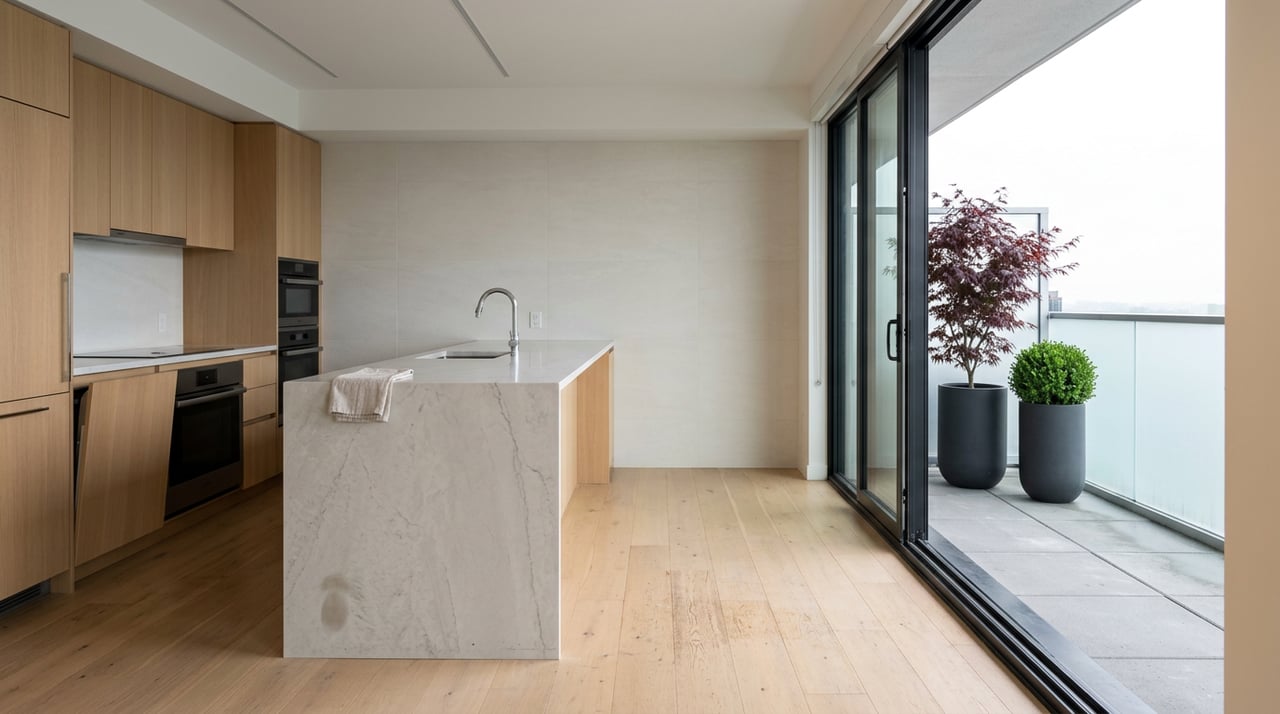
Toronto's New-vs-Resale Condo Gap Just Hit a Record, and It Isn't About Value
Walk from the Distillery District into Canary District and you'll cross maybe four streets. Keep walking toward East Bayfront and you're still inside a fifteen-minute loop. Yet if you priced condos along that walk this summer, you'd find three different markets behaving like they belong to three different cities. That's not a coincidence. It's the clearest local evidence of something bigger happening across Toronto's condo market right now: the price a builder lists and the price a unit actually sells for have stopped agreeing with each other, and the size of that disagreement just hit a record.
In the second quarter of 2026, developers were asking an average of $1,186 per square foot for completed, unsold new condos across the Greater Toronto and Hamilton Area, according to Urbanation's Q2-2026 Condominium Market Survey. Resale units in buildings registered within the past three years, essentially the closest apples-to-apples comparison available, sold for an average of $830 per square foot over the same period. That's a 43 percent premium for new over resale, the widest spread Urbanation has recorded. A quarter earlier, in Q1, the gap had already reached a then-record 38 percent, with new asking prices at $1,189 psf against resale at $859 psf.
Here's the part that should stop a buyer mid-scroll: that gap grew even as sales in Q2 came in well below asking. Urbanation's report notes that when new condo sales did happen last quarter, some bulk transactions to investment groups closed at prices even below resale comps. The number on the sign and the number on the closing document are no longer the same story.
| Metric | Q1 2026 | Q2 2026 |
|---|---|---|
| New, completed, unsold asking price (psf) | $1,189 | $1,186 |
| Resale price, buildings registered within 3 years (psf) | $859 | $830 |
| Gap between new asking and resale | 38% | 43% |
The obvious question is why a builder would hold a list price at a 43 percent premium when nobody's paying it. The answer has less to do with what the unit is worth and more to do with what the price needs to protect.
A big share of the units completing right now were sold on paper back in 2021 and 2022, when prices were at their peak. Those original buyers are closing this year, and their mortgages depend on an appraisal that comes close to what they agreed to pay years ago. If a developer starts publicly slashing list prices on the units still sitting unsold in the same building, it makes that appraisal harder to defend for every other buyer in the tower who's trying to close.
That's part of why Ontario's newly announced full HST rebate matters more than it looks like on the surface. Urbanation estimates the rebate lowers the effective price of unsold new condos by roughly $100,000 on average, enough to theoretically narrow the 38 percent gap down closer to 20 percent, without a developer ever touching the number on the price sheet. The rebate is doing the discounting so the list price doesn't have to.
Meanwhile the actual math on the ground tells a rougher story. A pre-construction specialist quoted in Real Estate Magazine this spring put it plainly: builders hate sitting on finished, unsold inventory, and the rebate and reduced development charges are being used as reasons to get buyers back in the door, layered on top of additional discounts that never show up in the advertised price. That's the real mechanism. The list price holds the line for existing buyers and lenders. The actual deal gets negotiated in private, often well underneath it.
For anyone shopping new versus resale in the same stretch of the east end right now, that means the psf on the builder's price sheet tells you almost nothing about what you could actually pay. It's a starting position, not a market signal.
The east downtown corridor makes this local because the divergence isn't uniform even within a fifteen-minute walk.
None of these are contradictions. They're what happens when a glut in one product type, large investor-grade towers built for the 2021 boom, gets compared against a totally different product type, smaller owner-occupied buildings, as if they were the same market. They aren't.
The scale of unsold inventory right now is genuinely unusual. Urbanation counted 4,295 completed, unsold new condos across the GTHA at the end of Q1 2026, more than double the year before, representing about 92 months of supply based on the prior year's sales pace. Another 8,629 unsold units were still under construction. The first quarter of 2026 also saw zero new condo project launches, the first time that's happened in at least 30 years of Urbanation tracking.
That glut is what's driving the price gap and the discounting happening beneath it. But it's worth separating today's standing inventory from tomorrow's pipeline, because they're moving in opposite directions. Full-year condo completions in 2026 are projected to fall to about 21,850 units, down from nearly 30,000 in each of 2024 and 2025, according to reporting from Global News on Urbanation's data. With no new projects launching and financing still tight for developers, the units completing in 2028 and beyond will be a fraction of what's finishing this year.
In other words, the record price gap between new and resale right now is a snapshot of a market working through a specific wave of overbuilt supply from the 2021 and 2022 boom. It isn't a permanent new baseline. Buyers evaluating a unit today in Canary District or East Bayfront are shopping into the tail end of that wave, not the start of a new one.
Does a 43 percent gap mean new condos are overpriced? Not necessarily. It means the asking price and the deal price are two different numbers right now, and only one of them reflects what buyers are actually paying. The listed psf on a new unit tells you what the developer needs the paper to say for financing reasons, not what they'll accept.
Should I wait for prices to fall further? Nobody can tell you that with certainty, and anyone who says otherwise is guessing. What the data does show is that the deepest oversupply is tied to a specific batch of 2021 to 2022 completions that's working through the system now, while the pipeline behind it is shrinking fast.
How do I find out what a builder will actually take, if the list price doesn't say it? That takes pulling recent comparable closings in the same building, not just the current price sheet, and understanding which incentives are being layered on quietly. It's the kind of homework that's hard to do from a listing portal alone.
If you're weighing a new-build unit against a resale option in Corktown, Canary District, or anywhere else in Toronto's east end, the sticker price is the least useful number on the page. Blue Door Realty Group tracks the real comparables building by building, not just what's advertised. Request your free home valuation and let's look at what the numbers actually say about your specific building, not the market average.
Stay up to date on the latest real estate trends.

At Blue Door Realty Group, we believe every home is more than just a property — it’s the start of your next chapter. Our team is here to guide you with expertise, honesty, and care so you can move forward with confidence.

BLUE DOOR REALTY GROUP
4-50 Northline Rd Toronto ON M4B3E2