Scarborough Townhouse Living Guide for Space and Transit
You do not have to choose between condo convenience and detached-home upkeep. In Scarborough, townhouse living can offer a practical middle ground if you want more space, some outdoor spillover, and access to transit that fits your daily routine. If you are weighing your next move, this guide will help you understand how townhouses fit into Scarborough’s housing mix, what “space” really looks like here, and why location matters so much for commuting. Let’s dive in.
Scarborough has a more balanced housing mix than many buyers expect. In 2021, 37.2% of occupied private dwellings were single-detached homes, 9.6% were row houses, and 35.2% were apartments in buildings with 5 or more storeys. That means townhouses are a meaningful part of the local market, even if they are not the dominant housing type.
This matters because a townhouse often fills the gap between two very different options. If a condo feels too compact and a detached home feels like too much to manage, a townhouse can offer a more comfortable in-between choice. In Scarborough, that middle ground makes a lot of sense for a wide range of households.
Scarborough also tends to support larger households than Toronto overall. The average household size was 2.85 in Scarborough compared with 2.38 across Toronto, and 7.0% of Scarborough households were multigenerational. Those numbers help explain why ground-related homes continue to appeal to buyers who want flexibility without jumping straight to a detached property.
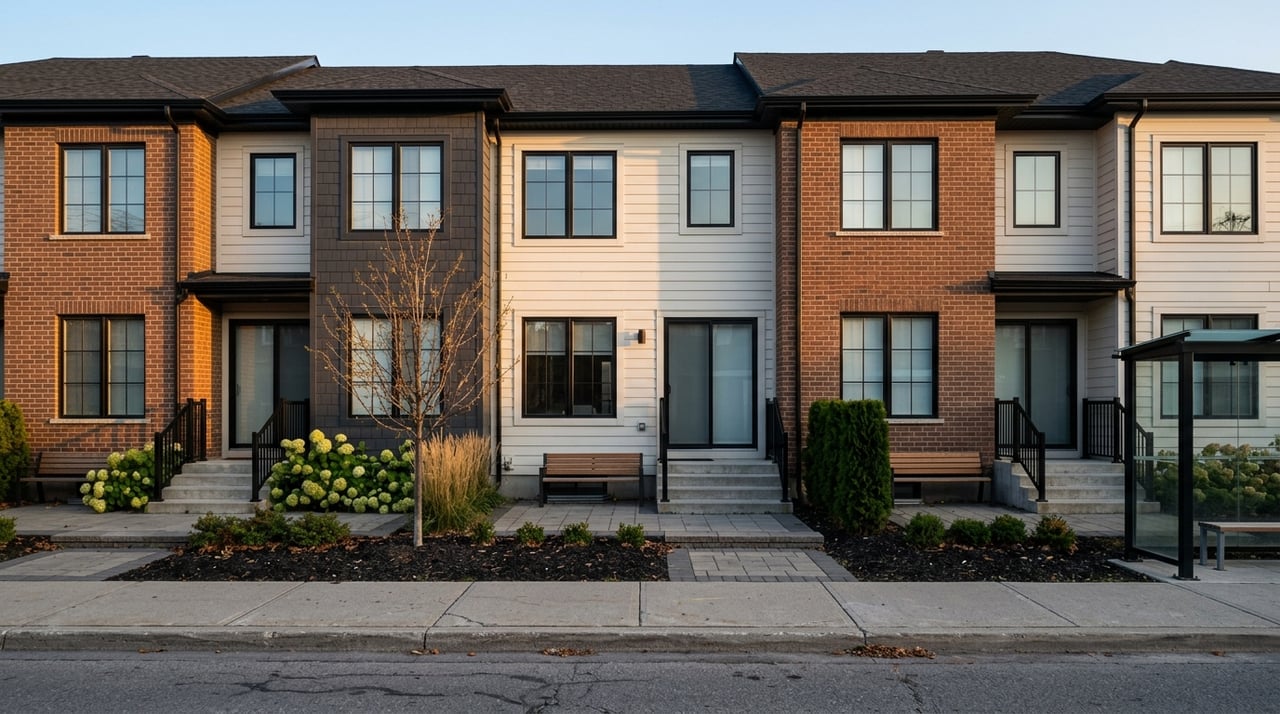
In Toronto’s census definitions, townhouses are row houses. That means three or more dwellings are joined side by side, with no other units above or below. It is a simple definition, but it helps clarify why townhouses often feel more like a small house than an apartment.
That structure shapes how the home functions day to day. You are usually getting a ground-related layout, which can make entrances, storage, and day-to-day movement feel more house-like. It also helps explain why buyers often connect townhouses with patios, terraces, or small yard areas, even though the exact outdoor setup depends on the specific development.
Ownership structure can vary too. In Scarborough, the City separates tenure from condominium status, and that is important because not every townhouse follows the same ownership model. Across all private dwellings, 64.0% were owned, 36.0% were rented, and 18.2% were condominiums, which is a reminder to look closely at how any specific townhouse community is set up.
If you are searching for more room, Scarborough townhouse data is encouraging. Row houses averaged 2.99 persons per household, almost the same as single-detached homes at 3.01, and well above apartments in buildings with 5 or more storeys at 1.97. In practical terms, that suggests townhouses regularly support family-scale living.
The pattern holds in newer homes too. For dwellings built from 2016 to 2021, row houses averaged 3.15 persons per household, compared with 3.89 for single-detached homes and 1.99 for high-rise apartments. A townhouse may not give you the same footprint as a detached house, but it can still offer enough room for a growing household.
This is one reason townhouses continue to attract buyers who want flexibility. You may need an extra bedroom, a home office, or room for relatives to stay over. A well-laid-out townhouse can often meet those needs while keeping maintenance more manageable than a detached property.
Outdoor space is one of the biggest reasons buyers look at townhouses in Scarborough. Because row houses are ground-related dwellings, they are generally easier to associate with patio, terrace, or yard potential than a high-rise apartment. That does not mean every townhouse has the same setup, but it does mean the housing form naturally allows for more direct connection to outdoor areas.
This is where your search needs to stay specific. One townhouse may have a fenced patio, another may offer a rooftop terrace, and another may have only a small front or rear outdoor area. The key is to evaluate each project on its actual layout rather than assuming every townhouse will deliver the same kind of outdoor living.
Compared with a detached home, the tradeoff is usually clear. Detached houses have open space on all sides, which typically means more privacy and more outdoor room. A townhouse often gives you some of that indoor-outdoor feel, but in a smaller, lower-maintenance format.
Scarborough is not just a story of brand-new development. About 36.9% of private dwellings were built from 1961 to 1980, and 22.1% were built in 1960 or earlier. That gives many parts of Scarborough an established residential fabric that can feel very different from a newly built condo node.
For townhouse buyers, that can be a plus. Some homes are part of mature areas with long-standing streetscapes and older housing stock, while others are tied to newer development patterns. Your experience of townhouse living may vary a lot depending on whether you are shopping in an established pocket or a more recently built enclave.
That contrast also matters when comparing Scarborough with Scarborough Centre. The City’s housing report describes Scarborough Centre as predominantly high-rise, with only 2% ground-related housing and 95% of dwellings built since 1991. If you want a more ground-related lifestyle, your search may naturally expand beyond the most condo-heavy core.
Transit is one of the biggest variables in Scarborough townhouse living. Two homes can offer similar interior space, but feel completely different depending on how easily you can get to rapid transit. That is why location-specific advice matters here more than broad generalizations.
Kennedy Station is a major anchor for eastern Scarborough. The TTC identifies it as an accessible station with direct connections to GO Transit and Line 5 Eglinton, and Kennedy GO is connected by passageway. If your townhouse search puts you within a practical connection to Kennedy, that can change your daily commute in a meaningful way.
The TTC’s 86 Scarborough bus also plays an important role. It runs between Kennedy Station and the Toronto Zoo, Highland Creek, and Beechgrove areas, operates all day every day, and one or more branches are part of the 10-Minute Network. For many townhouse areas, that means bus access is the first link in the trip, not an afterthought.
Scarborough buyers need to think about both the present and the future. Right now, transit access depends heavily on your bus connection, your distance to major stations, and how often you need rapid transit for work or school. A home that looks convenient on a map may still feel very different in real life depending on transfers and travel times.
Future transit improvements are also shaping how people think about location. The TTC says the Scarborough Busway is scheduled to enter service in Fall 2026, replacing decommissioned Line 3 service and running from Kennedy Station to Scarborough Town Centre via Lawrence East Station and Ellesmere Station. Metrolinx also says the Scarborough Subway Extension will extend Line 2 nearly 8 km farther into Scarborough, with three stations and connections to GO, Line 5, Durham Region Transit, and TTC buses.
That does not mean every area will benefit in the same way. Homes near Kennedy, Line 5, or the Scarborough Centre growth area will likely feel different from more bus-dependent pockets farther from rapid transit. If transit is high on your list, your home search should focus less on broad postal codes and more on exact route patterns and station access.
Townhouses can work well for several types of buyers in Scarborough. Local household data shows a strong base of couple-family households at 46.2%, one-parent households at 12.4%, and multigenerational households at 7.0%. There is also a meaningful share of households with four or more people.
That mix helps explain why townhouses remain so relevant. They can suit first-time buyers moving up from a condo, growing households that need more separation between living areas, or buyers who want ground-related living without taking on the full cost and maintenance of a detached home. In short, they serve real day-to-day needs, not just a price point.
CMHC describes missing-middle housing, including row homes and stacked townhouses, as ground-oriented housing that can broaden choices for families who may not be able to afford detached homes and may find high-rise apartments too small. In Scarborough, that description lines up closely with how many buyers approach the market.
Choosing the right home type usually comes down to tradeoffs. Scarborough gives you all three major options, but they do not solve the same problem. A quick comparison can help you narrow your search.
| Home type | What it often offers | What to keep in mind |
|---|---|---|
| Townhouse | Ground-related layout, family-scale living, possible patio or terrace, lower maintenance than detached | Outdoor space and ownership structure vary by project |
| Condo | More vertical living, often closer to condo-heavy nodes like Scarborough Centre | Usually less direct outdoor spillover than a townhouse |
| Detached home | Most privacy and open space on all sides | Usually more upkeep and a larger land commitment |
If you are trying to balance space, outdoor use, and commute options, the townhouse category deserves a close look. It is often the home type that lets you stretch into a more functional layout without fully stretching into detached-home responsibilities.
A townhouse search works best when you stay practical. It is easy to get drawn in by square footage alone, but day-to-day livability often comes down to layout, outdoor use, and transit connections. In Scarborough, those details can vary a lot from one pocket to the next.
As you compare options, focus on a few basics:
A good search is not just about finding a townhouse. It is about finding the right kind of townhouse for how you actually live.
If you are exploring Scarborough townhouse living and want clear, data-informed guidance on where space, outdoor potential, and transit access line up best, Dimitri Kalkounis can help you make a smart move with boutique service and local insight.
Stay up to date on the latest real estate trends.

At Blue Door Realty Group, we believe every home is more than just a property — it’s the start of your next chapter. Our team is here to guide you with expertise, honesty, and care so you can move forward with confidence.

BLUE DOOR REALTY GROUP
4-50 Northline Rd Toronto ON M4B3E2